NUNTIUS
Before there was an architecture family, there was the first app.
Nuntius is my radio-first creator command center: built in Rust as a deliberate lightweight alternative to creator platforms that turn a simple broadcast into a stack of hungry services.
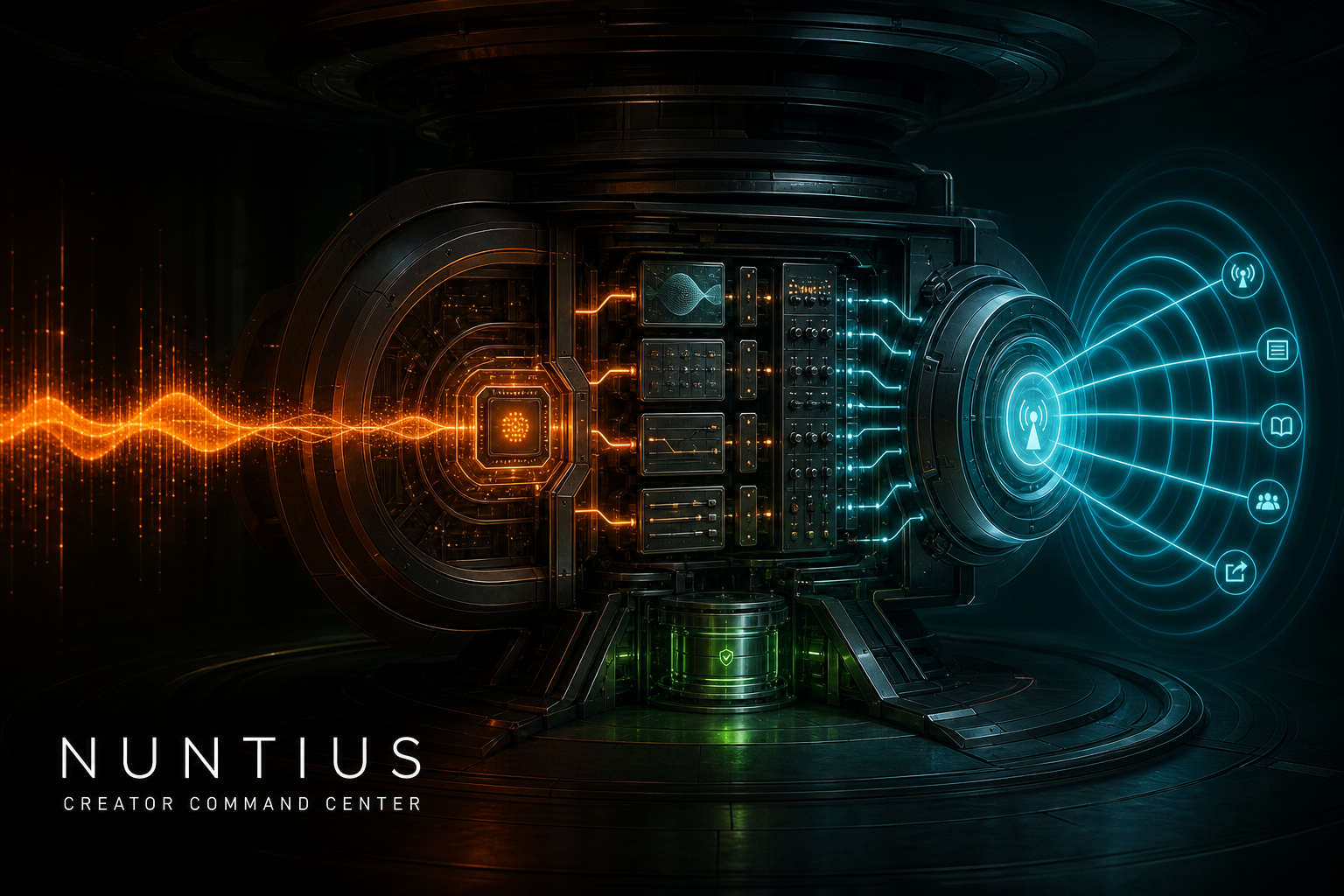
Open every room
in the station.
Explore the current radio, publishing, audience, production, and plugin surfaces. Built, optional, and scaffold-stage capabilities stay visibly labeled instead of being presented as equally complete.
Radio · Studio
Operate the live station, AutoDJ handoff, relay, ingest, and master broadcast path.
The app that made the rest feel possible.
Nuntius matters beyond its feature list. It is the first finished shape of the impulse that still drives this work: own the runtime, keep the architecture legible, and refuse to spend a machine just to operate a creative tool.
A station,
not a service pile.
The repository is a Rust workspace whose parts meet through a compact application context: embedded data, a typed service registry, and Tokio broadcast events.
Radio engine
AutoDJ, live ingest, PCM crossfading, EBU R128 loudness, and one broadcast sender fanning the master stream out to listeners.
Creator surface
Radio, writing, podcasts, video, newsletters, live chat, and ActivityPub live inside one self-hosted command center.
Embedded state
redb owns local durable data. There is no separate SQL service to install, tune, or keep alive beside the application.
Plugin boundary
Capabilities are registered as Rust plugins, and a disabled plugin is never constructed—keeping optional systems genuinely optional.
Less machinery
between creator
and audience.
“Lightweight” is the design target. The source supports the structural case below; a public RAM and CPU benchmark has not yet been published.
One application shape
The workspace builds the command center as a single Rust application instead of coordinating a fleet of web services.
No external database
redb is embedded directly. Backups are files; operation does not depend on a separate SQL daemon.
Templates compile in
Askama templates are checked and compiled with the application. Public interaction uses small vanilla scripts and vendored HTMX—not a full client framework.
Optional means absent
Disabled plugins are not merely hidden in the interface; they are never constructed by the plugin manager.
The architecture is intentionally lean, but “lighter than hardware hogs” remains a product goal until repeatable memory, CPU, startup, and stream-load benchmarks are published.
Broadcast.
Publish.
Own the room.
24/7 radioAutoDJ, live takeover, relays, recording, loudness normalization
Owned publishingBlog, podcast feeds, video, newsletter, ActivityPub
Listener presencePublic station pages, live chat, media controls, SSE updates
Self-hosted stateYour media, audience surface, and database stay under your control
Nuntius is not being retrofitted into the Atom story. Its current source has no Atom dependency and its event bus is Tokio broadcast, not Spiderweb. It belongs here because it came first—and because independent work deserves the same architectural care.